

Competitive gaming no longer relies on instinct and practice alone. Today, esports analytics stands at the core of performance improvement, using advanced tools to break down strategy, skill, and team coordination with unmatched precision. For American analysts and data-driven gamers, mastering these analytical concepts means transforming raw match data into powerful insights that can shape winning strategies and drive ongoing success.
Table of Contents
Defining Esports Analytics And Core Concepts
Key Types Of Esports Analytics Used Today
How Esports Analytics Shapes Game Strategies
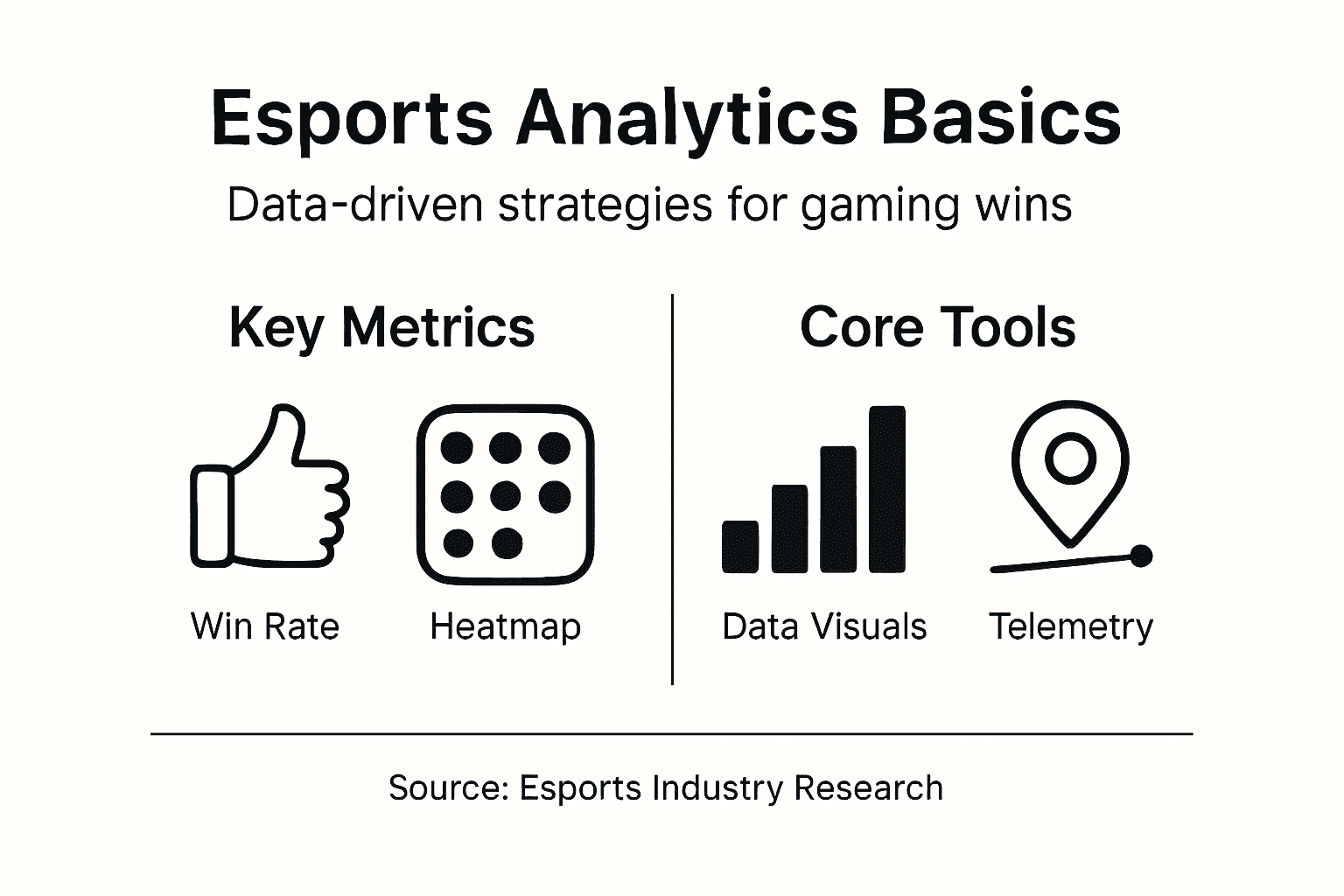
Essential Tools And Data Sources For Analytics
Risks, Missteps, And Limitations To Avoid
Key Takeaways
| Point | Details |
|---|---|
| Esports Analytics Definition | Esports analytics utilizes data-driven methods to enhance competitive gaming performance through performance tracking and strategic evaluation. |
| Types of Analytics | Key types include Player Performance Metrics, Team Strategy Analytics, and Predictive Modeling, allowing for comprehensive understanding and decision-making. |
| Strategic Impact | Analytics inform pre-match planning, in-game adjustments, and post-match refinement, transforming data into actionable strategic intelligence. |
| Risks and Ethical Considerations | Professionals must navigate risks such as ethical concerns and analytical missteps to ensure player well-being and data integrity is maintained. |
Defining Esports Analytics and Core Concepts
Esports analytics represents a sophisticated data-driven approach to understanding and improving competitive gaming performance. By leveraging advanced statistical methods and technological tools, analysts can now dissect player and team strategies with unprecedented precision. Comprehensive esports research highlights the complex multidimensional nature of competitive gaming analytics.
At its core, esports analytics encompasses several critical dimensions:
- Performance tracking and statistical measurement
- Player behavior and psychological pattern analysis
- Team strategy optimization
- Individual skill development assessment
- Predictive modeling for match outcomes
The evolution of esports analytics goes beyond traditional sports metrics by incorporating unique digital environment factors. Unlike physical sports, esports provides granular data points from game logs, player movements, reaction times, and strategic decision-making sequences. These detailed datasets allow for nuanced performance evaluation that transcends surface-level observations.
Professional teams and players increasingly rely on analytics to gain competitive advantages. By transforming raw game data into actionable insights, analysts can help players refine techniques, identify strategic weaknesses, and develop targeted improvement plans. Modern esports analytics bridges technology, psychology, and competitive strategy into a comprehensive performance enhancement framework.
Pro tip: Invest in learning data visualization and statistical analysis tools to transform raw gaming data into meaningful performance insights.
Key Types of Esports Analytics Used Today
Advanced gaming analytics have revolutionized competitive gaming by transforming raw data into strategic insights. These sophisticated analytical approaches provide teams and players with unprecedented performance evaluation capabilities, enabling them to make data-driven decisions that can dramatically improve competitive outcomes.
The primary types of esports analytics can be categorized into several key dimensions:
Player Performance Metrics
- Individual skill tracking
- Reaction time analysis
- Precision and accuracy measurements
- Consistency evaluation
Team Strategy Analytics
- Strategic pattern recognition
- Tactical decision-making assessment
- Comparative team performance analysis
- Communication and coordination metrics
Predictive Modeling
- Match outcome probability calculations
- Player potential prediction
- Strategic weakness identification
- Performance trend forecasting
Esports analytics go beyond traditional statistical tracking by incorporating complex technological tools that capture intricate gameplay nuances. Advanced algorithms and machine learning techniques can now analyze millisecond-level interactions, providing insights that were previously impossible to detect. These systems integrate real-time data processing, allowing instant performance feedback and strategic adjustments during competitive events.
Complex data analysis transforms raw gaming interactions into actionable strategic intelligence.
Professional esports organizations increasingly rely on these analytical frameworks to develop comprehensive training programs, optimize player rosters, and design targeted improvement strategies. By understanding granular performance metrics, teams can create personalized development plans that address specific skill gaps and enhance overall competitive potential.
Pro tip: Develop proficiency in data visualization and statistical analysis tools to effectively translate complex gaming data into meaningful performance insights.
How Esports Analytics Shapes Game Strategies
Machine learning models in competitive gaming have fundamentally transformed how teams develop and execute strategic approaches. By converting complex gameplay data into actionable insights, analytics enable precise strategic planning that goes far beyond traditional intuition-based decision-making.
The strategic impact of esports analytics manifests through several critical dimensions:
Pre-Match Strategic Planning
- Opponent behavior prediction
- Weakness identification
- Counter-strategy development
- Risk assessment modeling
In-Game Tactical Adjustments
- Real-time performance tracking
- Adaptive strategy modifications
- Dynamic resource allocation
- Momentum shift recognition
Post-Match Strategic Refinement
- Comprehensive performance review
- Detailed error analysis
- Strategic pattern recognition
- Long-term improvement planning
Advanced analytical techniques allow teams to deconstruct gameplay into granular components, examining everything from individual player movements to team-wide communication patterns. These sophisticated approaches transform raw data into strategic intelligence, enabling teams to anticipate opponent actions, optimize resource management, and develop highly targeted improvement strategies.
Predictive analytics convert complex gameplay interactions into strategic advantages.
The most successful esports organizations now treat data analysis as a critical competitive tool. By leveraging machine learning algorithms and advanced statistical models, teams can create dynamic strategic frameworks that adapt in real-time, providing unprecedented levels of competitive insight and strategic flexibility.

Pro tip: Develop a systematic approach to collecting and analyzing gameplay data, focusing on consistent metrics that reveal meaningful strategic patterns.
Essential Tools and Data Sources for Analytics
Data mining techniques in esports have revolutionized how competitive gaming teams collect, process, and leverage performance information. Modern analytics tools transform raw gameplay data into sophisticated strategic insights, enabling teams to make precise, data-driven decisions that can dramatically influence competitive outcomes.
Esports analytics professionals rely on multiple critical data sources and tools:
Game Telemetry Sources
- In-game event tracking
- Player movement logs
- Action sequence recordings
- Performance metric captures
Statistical Analysis Tools
- Machine learning platforms
- Advanced regression models
- Clustering algorithms
- Predictive analytics software
Data Collection Platforms
- Official game APIs
- Third-party tracking systems
- Tournament management databases
- Player performance repositories
Advanced analytics frameworks integrate multiple data streams to create comprehensive performance profiles. By combining granular gameplay metrics with sophisticated computational models, teams can develop nuanced understanding of individual and collective performance dynamics, identifying subtle patterns that traditional observation might miss.
Here’s how major esports analytics tools contribute to competitive gaming:
| Tool Type | Primary Function | Business Impact |
|---|---|---|
| Game Telemetry Systems | Capture real-time player actions | Enables precise skill assessments |
| Statistical Analysis Software | Analyze performance metrics | Identifies roster improvement needs |
| Machine Learning Platforms | Predict match and player trends | Optimizes strategy and roster moves |
| Data Collection Platforms | Aggregate and centralize game data | Speeds up decision-making |
Raw data becomes strategic intelligence through sophisticated analytical processing.
The most effective analytics approaches combine technical sophistication with deep gaming domain knowledge. Professionals must not only understand complex statistical techniques but also interpret data within the specific context of competitive gaming environments, translating numbers into actionable strategic recommendations.
Pro tip: Develop cross-disciplinary skills in data science, gaming mechanics, and statistical analysis to become a more effective esports analytics professional.
Risks, Missteps, and Limitations to Avoid
Collegiate esports integrity risks reveal critical challenges that analytics professionals must carefully navigate. While data-driven approaches offer powerful insights, they also introduce complex ethical and methodological considerations that can potentially undermine performance optimization if not strategically managed.
Key risks and potential limitations in esports analytics include:
Ethical Concerns
- Data privacy violations
- Player psychological manipulation
- Unintended performance pressure
- Potential discrimination through metrics
Analytical Missteps
- Over-reliance on quantitative data
- Misinterpreting statistical correlations
- Ignoring contextual gameplay nuances
- Creating reductive performance models
Technical Vulnerabilities
- Data collection bias
- Algorithmic prediction limitations
- Inconsistent measurement standards
- Technology infrastructure gaps
Successful analytics approaches require a nuanced understanding that metrics represent complex human performance, not simply reducible numerical values. Professionals must balance technological capabilities with ethical considerations, recognizing that data interpretation involves sophisticated human judgment beyond raw computational analysis.
This table summarizes key risks and their consequences in esports analytics:
| Risk Category | Example Issue | Potential Harm |
|---|---|---|
| Ethical | Data privacy breaches | Loss of player trust |
| Analytical | Misleading metric interpretation | Faulty coaching advice |
| Technical | Biased data collection | Skewed performance evaluation |
| Psychological | Unintended performance pressure | Player burnout or stress |
Analytics effectiveness depends on understanding both technological capabilities and human complexity.
The most sophisticated esports analytics strategies integrate robust ethical frameworks, acknowledging the potential psychological impacts of data-driven performance evaluation. Teams must develop comprehensive approaches that respect player autonomy while providing meaningful performance insights.
Pro tip: Always prioritize player well-being and consent when developing performance analytics strategies, maintaining transparent communication about data collection and usage.
Elevate Your Esports Game with Data-Driven Insights
Mastering the complexities of esports analytics is essential for anyone serious about competitive gaming success. This article highlights the power of data to track player performance, optimize team strategies, and predict match outcomes. However, understanding how to analyze this data effectively while avoiding ethical pitfalls can be challenging. If you want to go beyond basic stats and truly transform your gameplay, tapping into expert resources is key.

Unlock the full potential of esports analytics through expertly crafted guides, tutorials, and industry updates on GZone Pro. Our platform delivers actionable insights on topics like machine learning models in gaming and predictive performance analysis that will help you sharpen your strategies. Don’t settle for guesswork. Visit GZone Pro now and embrace the data-driven edge that champions rely on to win.
Explore the future of competitive gaming on GZone Pro and start applying advanced analytics that elevate your play today.
Frequently Asked Questions
What is esports analytics?
Esports analytics is a data-driven approach that helps understand and improve competitive gaming performance by analyzing player strategies, behaviors, and performance metrics through advanced statistical methods.
How do esports analytics impact player performance?
Esports analytics impact player performance by providing actionable insights that help refine techniques, identify weaknesses, and develop targeted improvement plans, ultimately enhancing competitive potential.
What types of data are used in esports analytics?
Esports analytics utilize various types of data, including player performance metrics, game telemetry, statistical analysis tools, and predictive modeling to evaluate individual and team performance effectively.
What are the risks associated with esports analytics?
Risks associated with esports analytics include ethical concerns like data privacy violations, analytical missteps from over-reliance on data, and technical vulnerabilities such as data collection bias, all of which can impact player well-being and performance evaluation.